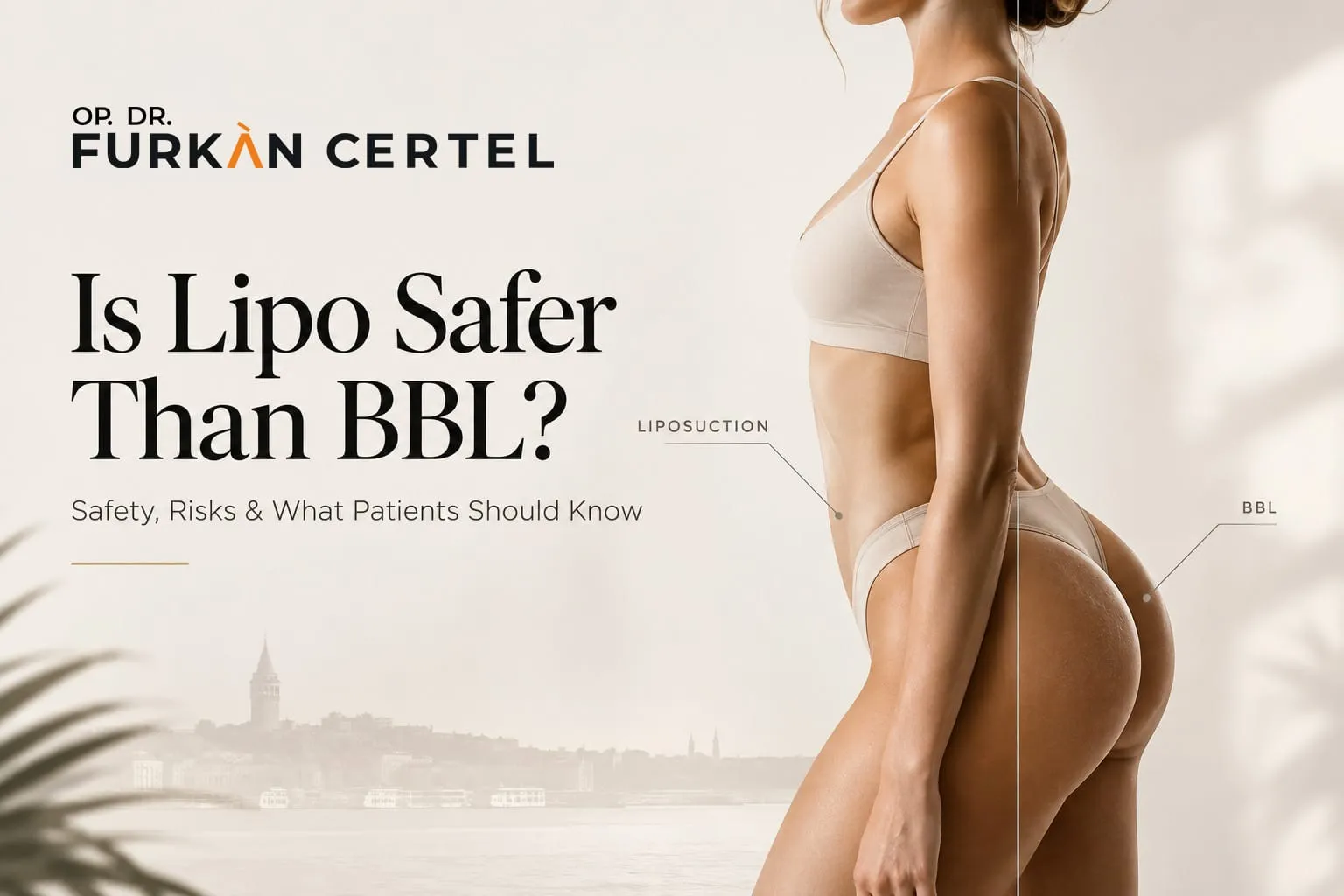


360 liposuction can produce beautiful, natural-looking results — but only when the right patient is selected.
In this guide, Dr. Furkan Certel explains what 360 liposuction is, who the best candidates are, how the operation is planned and performed safely, and how results develop during healing.
What Is 360 Liposuction?
360 liposuction, also known as circumferential liposuction, is a technique that treats the waistline as a complete circle.
Instead of focusing only on the front of the abdomen, the procedure addresses:
- Abdomen
- Flanks (love handles)
- Lower back
- Upper back, when needed
The goal is not aggressive fat removal, but balanced contouring that follows the body’s natural proportions.
How 360 Liposuction Differs from Traditional Liposuction
Traditional liposuction often treats isolated areas.
While this can reduce fat, it may create uneven transitions if surrounding areas are not addressed.
With 360 liposuction:
- The entire waistline is planned together
- Fat removal is distributed evenly
- Transitions between front, sides, and back are smoother
This approach helps avoid a “treated area” look and instead creates a continuous, natural silhouette.
Why Patient Selection Matters in 360 Liposuction
360 liposuction is a body contouring technique, not a universal solution.
When performed on the right candidate, it can:
- Enhance waist definition
- Improve overall body balance
- Create smooth, natural contours
When performed on the wrong candidate, even a technically correct surgery may lead to dissatisfaction.
This is why careful evaluation before surgery is essential.
Ideal Body Characteristics for 360 Liposuction
1. Stable Body Weight
The best candidates are usually close to their target weight and have maintained a stable weight for a period of time.
360 liposuction is not designed for significant weight loss, but for reshaping localized fat deposits.
2. Localized Fat Around the Waistline
Patients who benefit most often have stubborn fat in areas such as:
- Abdomen
- Love handles
- Lower back
These fat deposits typically do not respond well to diet or exercise alone.
3. Good Skin Elasticity
Skin quality plays a major role in final results.
When the skin has good elasticity, it can adapt smoothly to the new contour after fat removal.
Reduced elasticity does not automatically exclude surgery, but it may affect expectations or require additional planning.
4. Balanced Body Proportions
360 liposuction works best when it enhances natural body proportions, rather than trying to correct extreme imbalances.
The goal is always to work with the body — not against it.
Candidates Who May Need Additional Consideration
Not every patient is an ideal candidate for standalone 360 liposuction.
Extra evaluation is needed when:
- There is significant skin laxity
- Body weight is not stable
- Expectations are unrealistic
- There are medical conditions that increase surgical risk
In some cases, combining procedures or choosing an alternative treatment may lead to safer and more satisfying outcomes.
The Role of Expectations
A successful result is not defined only by what happens during surgery, but by how well the patient understands the process.
Good candidates typically:
- Understand that results take time
- Accept natural variation in healing
- Value proportion over exaggeration
Clear communication before surgery helps ensure satisfaction after recovery.
Age and 360 Liposuction
Age alone is not a limiting factor for 360 liposuction.
What matters more than age is:
- Skin quality
- Overall health
- The body’s healing capacity
Patients of different ages can achieve excellent results when these factors are favorable.
The Importance of Surgical Planning
In my practice, 360 liposuction starts long before surgery.
I carefully evaluate:
- Fat distribution
- Skin elasticity
- Muscle structure
- Body proportions from all angles
Every body is different, and the same surgical plan should never be repeated for every patient.
Precise planning allows me to sculpt the waist while maintaining natural harmony rather than exaggerated contours.
Fat Removal vs. Body Sculpting
Removing fat is only one part of the process.
Surgical planning focuses on:
- Where fat should be removed
- How much fat should be removed
- Where fat should be preserved for smooth transitions
Over-removal can lead to irregularities and unnatural contours.
Precision and balance are far more important than aggressive reduction.
Anesthesia and Safety Considerations
360 liposuction is performed under general anesthesia in fully equipped hospital settings.
Safety depends on:
- Proper patient selection
- An experienced anesthesia team
- Controlled surgical time
- Professional post-operative monitoring
When these elements come together, the procedure is both effective and safe.
Medical Evaluation and Safety
Before approving a patient for surgery, a full medical evaluation is performed, including:
Safety data supports this careful screening: in an analysis of 31,010 liposuction procedures published in the Aesthetic Surgery Journal, liposuction performed alone had a major complication rate of 0.7%, while combined procedures, especially in obese or older patients, can significantly increase complication rates.
- Medical history
- Lifestyle factors
- Body composition
- Overall surgical risk profile
Patient safety always comes before aesthetic goals.
Safety Comes Before Aesthetics
In Dr. Furkan Certel’s practice, safety is not negotiable.
Operating time is part of safety too: an analysis of 1753 plastic surgery cases published in the Aesthetic Surgery Journal found that each additional hour of surgery was associated with a 21% rise in the odds of complications.
This includes:
- Careful patient selection
- Thorough pre-operative evaluation
- Operating in accredited hospitals
- Working with experienced anesthesia teams
Aesthetic goals are always secondary to patient well-being.
What Defines a “Good” 360 Liposuction Result?
A successful 360 liposuction result is not dramatic or exaggerated.
Instead, it should:
- Look natural from every angle
- Maintain smooth transitions between treated areas
- Respect the patient’s body structure
- Age well over time
True success is when the body looks balanced — not “operated on.”
Symmetry, Proportion, and Natural Aesthetics
Every body has natural asymmetries.
Rather than forcing perfect symmetry, the goal is to:
- Improve overall proportion
- Enhance natural curves
- Avoid sharp or artificial lines
This approach leads to results that feel authentic and comfortable for the patient.
Healing and Result Development
Patients should understand that results develop gradually.
- Early swelling is normal
- Shape becomes clearer over several weeks
- Final contours appear over 3 to 6 months
This natural healing process is part of achieving smooth, long-lasting results.
Experience With Circumferential Body Contouring
360 liposuction is more complex than treating a single area.
It requires:
- Planning the body from all angles
- Understanding how different zones interact
- Maintaining balance between fat removal and preservation
Experience allows a surgeon to anticipate challenges, minimize risk, and avoid common complications.
The Role of Follow-Up and Aftercare
Choosing a surgeon also means choosing a system of care.
Post-operative follow-up helps:
- Monitor healing
- Address concerns early
- Support optimal recovery
Long-term satisfaction depends on proper aftercare — not just the operation itself.
Frequently Asked Questions (FAQ)
- Is there a BMI limit for 360 liposuction?
There is no universal number. BMI is evaluated together with fat distribution, skin quality, and overall health. - Can I have 360 liposuction if I want to lose weight?
360 liposuction is not a weight-loss method. Weight loss should come before considering surgery. - Is 360 liposuction suitable for men?
Yes. Men can be good candidates when fat distribution and skin quality are appropriate. - What if my skin is not very tight?
Reduced elasticity does not always exclude surgery, but results may be more subtle and are discussed during consultation. - How do I know if I am a good candidate?
A personal consultation and medical evaluation are the only reliable ways to determine suitability. - How long does the surgery take?
Depending on the case, it usually takes between 2 and 4 hours. - When will I see final 360 liposuction results?
Final results usually appear between 3 and 6 months after surgery.
Final Thoughts
The best 360 liposuction results are achieved before the operation even begins — through careful patient selection and honest communication.
Choosing the right candidate protects both the patient and the outcome.
The responsibility of a surgeon is not only to perform surgery, but to guide patients toward the safest and most natural result possible.
Sources
- Liposuction American Society of Plastic Surgeons
- Liposuction NHS, 2023
- Liposuction MedlinePlus Medical Encyclopedia (U.S. National Library of Medicine), 2025
- Cosmetic Liposuction: Preoperative Risk Factors, Major Complication Rates, and Safety of Combined Procedures Aesthetic Surgery Journal, 2017
- Choosing a Plastic Surgeon for Liposuction American Society of Plastic Surgeons
- Liposuction Risks and Safety American Society of Plastic Surgeons
- The impact of operative time on complications after plastic surgery: a multivariate regression analysis of 1753 cases Aesthetic Surgery Journal, 2014
- Liposuction Results American Society of Plastic Surgeons